Lowest Common Ancestor of a Binary Tree II
Given the root of a binary tree, return the lowest common ancestor (LCA) of two given nodes, p and q. If either node p or q does not exist in the tree, return null. All values of the nodes in the tree are unique.
According to the definition of LCA on Wikipedia: "The lowest common ancestor of two nodes p and q in a binary tree T is the lowest node that has both p and q as descendants (where we allow a node to be a descendant of itself)". A descendant of a node x is a node y that is on the path from node x to some leaf node.
Example 1:
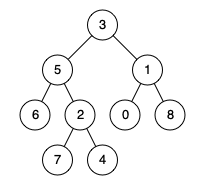
Input: root = [3,5,1,6,2,0,8,null,null,7,4], p = 5, q = 1
Output: 3
Explanation: The LCA of nodes 5 and 1 is 3.
Example 2:
Input: root = [3,5,1,6,2,0,8,null,null,7,4], p = 5, q = 4
Output: 5
Explanation: The LCA of nodes 5 and 4 is 5. A node can be a descendant of itself according to the definition of LCA.
Example 3:
Input: root = [3,5,1,6,2,0,8,null,null,7,4], p = 5, q = 10
Output: null
Explanation: Node 10 does not exist in the tree, so return null.
Constraints:
- The number of nodes in the tree is in the range
[1, 104]. -109 <= Node.val <= 109- All
Node.valare unique. p != q
Follow up: Can you find the LCA traversing the tree, without checking nodes existence?